
Note: Companies like NVIDIA, AMD, Apple, and Huawei design chips but do not manufacture them. The actual manufacturing is done by foundries like TSMC, SMIC, and UMC. This post is about foundries.
I. A young workforce in an old person’s game?
Advanced chips power artificial intelligence, and whether China can manufacture them domestically is a central question in AI governance and geopolitics today. An underexplored angle is the country’s chipmaking workforce.
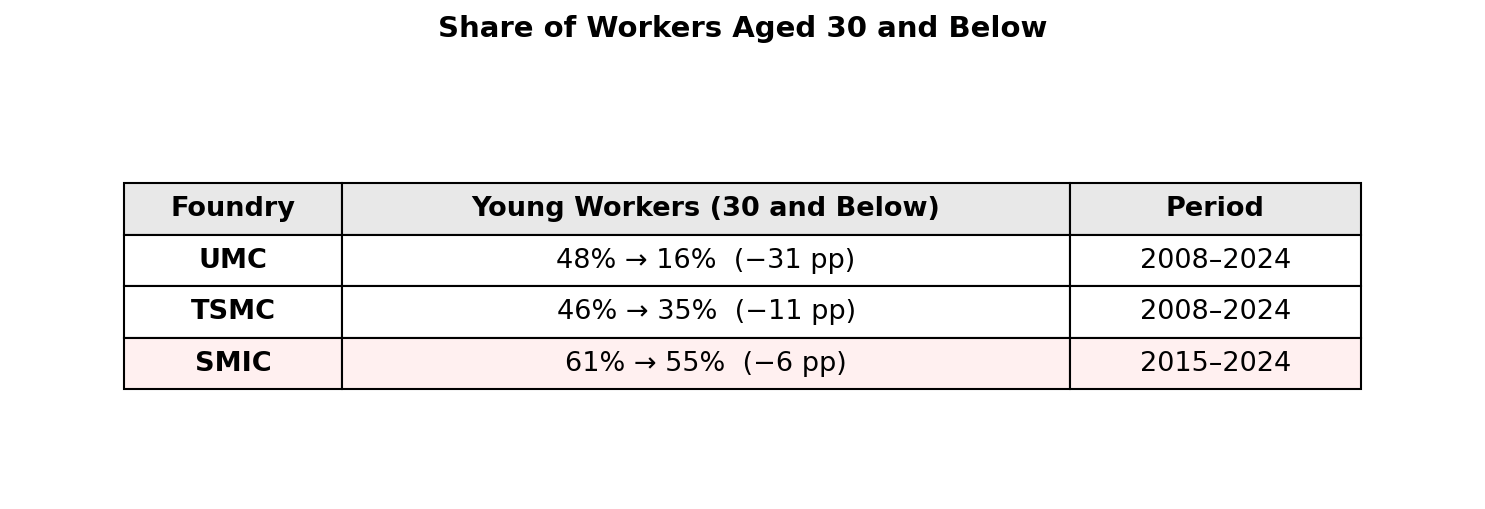
In 2024, 55% of the workforce at Semiconductor Manufacturing International Corporation (SMIC), China’s national champion chipmaker, was aged 30 or below.
At Taiwan Semiconductor Manufacturing Company (TSMC), the world’s leading foundry, the figure was 35%. At United Microelectronics Corporation (UMC), another major Taiwanese foundry, it was 16%.
In an industry where expertise compounds over decades and the most valuable knowledge cannot be written down, SMIC’s workforce is young and inexperienced relative to its competitors.1 As this blog post will show, the company also does not retain workers long enough for them to become experienced.
II. What Taiwan understood
In 1973, Taiwan established the Industrial Technology Research Institute (ITRI), a government research lab tasked with bootstrapping Taiwan’s semiconductor industry from nothing. Interestingly, ITRI deliberately aimed for 15% annual staff turnover. Engineers trained at ITRI were expected to leave and join private industry, carrying their knowledge with them.
By the late 1990s, about 40% of managers at firms in Taiwan’s Hsinchu Science Park had come through ITRI. Both UMC (founded 1980) and TSMC (founded 1987) were ITRI spinoffs. Taiwan, like Silicon Valley before it, understood that semiconductor knowledge lives in people.
But ITRI was not a company. It was a knowledge diffusion engine, and its whole purpose was to seed the ecosystem. A firm needs the opposite—it needs experienced people to stay.
III. Why experience matters in a fab
There is an old story, probably apocryphal, about a retired engineer who gets called back when a machine breaks down and nobody at the plant can fix it. He walks in, looks at the machine, picks up a hammer, hits it once, and it starts. He sends a bill for $5,000. When the company demands an itemized invoice, the engineer writes: “Hammer: $5. Knowing where to hit the machine with hammer: $4,995.”
Tacit knowledge is the kind of expertise that cannot be written down in a manual. In semiconductor fabs, tacit knowledge matters more than almost anywhere else, for two reasons.
First, the feedback loop is slow. In software, a developer can test an idea in seconds. In a fab, a single wafer takes 14 to 20 weeks to move through the production cycle, passing through 600 to over 1,000 steps. An engineer might get two or three meaningful learning cycles per year.2 Experience compounds slowly, and losing an engineer with a decade of it means losing perhaps 20 to 30 hard-won iterations of trial and error.
Second, the cost of failure is immense. A single 300mm wafer at the leading-edge 3 nm node costs around $25,000-27,000, with 2 nm wafers priced at $30,000 and rising. A standard lot of 25 wafers therefore represents well over half a million dollars. A bad process change can destroy an entire lot.
Brian Potter, writing in Construction Physics, captures just how sensitive these processes are:
Early semiconductor manufacturers found that their processes were influenced by, among other things, the phase of the moon, whether workers had recently visited the bathroom, and female workers’ menstrual cycles.
And the problem has only gotten worse as features have shrunk:
As transistors shrank, Intel found that even the most innocuous equipment change — using a slightly longer pipe or cable, for instance — could cause process disruptions to new fabs and cause months or years of lower yields. To combat this, Intel instituted a process known as Copy EXACTLY! New fabs would be identical to existing fabs to the extent possible, right down to the color and brand of the paint on the walls.
When leading-edge chip features are measured in nanometers (for reference, a human hair is roughly 70,000 nanometers, or 0.07 millimeters, wide), semiconductor manufacturing requires well-timed steps at atomic-level precision. Each step’s outcome depends on every previous one. In this environment, the most valuable workers are the ones who have been around the longest, watching processes succeed and fail in specific ways.
Morris Chang, TSMC’s founder, argued in a 2023 speech that TSMC’s 4-5% annual turnover rate was central to its success. He contrasted it with the 15-20% turnover at American companies during the 1970s and 80s, and attributed America’s decline in semiconductor manufacturing partly to this churn. He said he could never figure out “how a semiconductor supplier with a turnover rate above 10 percent a year will make any significant achievement.”
IV. TSMC, UMC, and SMIC
In what follows, I focus on TSMC, UMC, and SMIC because they are the leading pure-play foundries that publish detailed workforce demographics in their annual Corporate Social Responsibility (CSR) and Environmental, Social, and Governance (ESG) reports. Samsung, GlobalFoundries, and others do not publish comparable data.
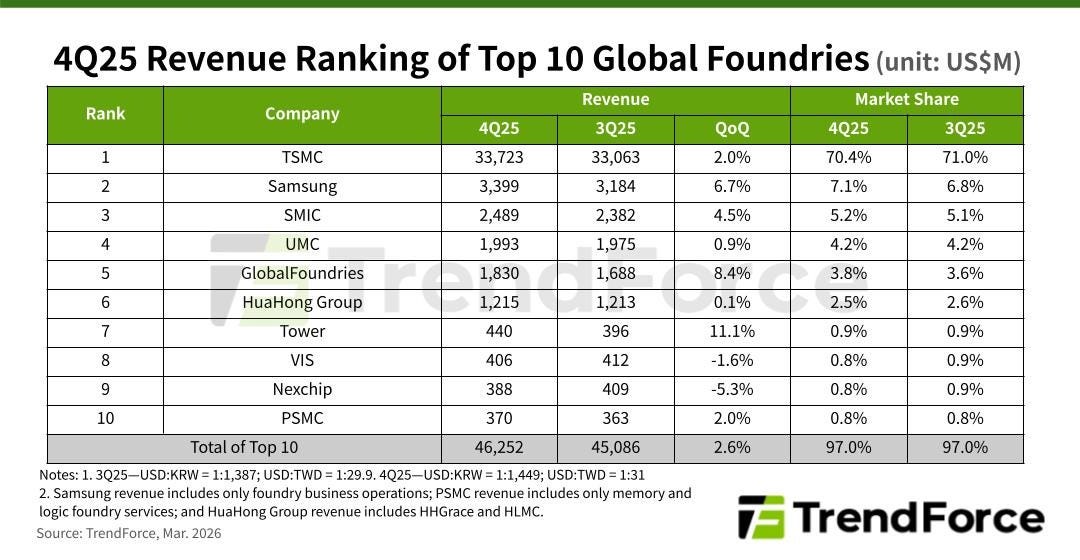
The three companies occupy different positions in the industry. TSMC holds roughly 70% global foundry revenue, and close to 80% of its wafer sales come from advanced process nodes of 7nm and below. It manufactures cutting-edge AI chips for NVIDIA, AMD, Apple, and Broadcom. UMC holds around 4% and competes by choice on mature nodes (22 nm and above).
SMIC holds around 5% and has historically derived most of its revenue from mature nodes. But SMIC is in a very different position from UMC. As China’s largest and most strategically important chipmaker, Beijing would very much like it to manufacture leading-edge chips. SMIC has been confirmed to manufacture 7 nm chips for Huawei smartphones, but at low yields (meaning a large share of chips on each wafer come out defective).3 SMIC is for now the only Chinese firm producing these advanced logic chips, although that may be changing.
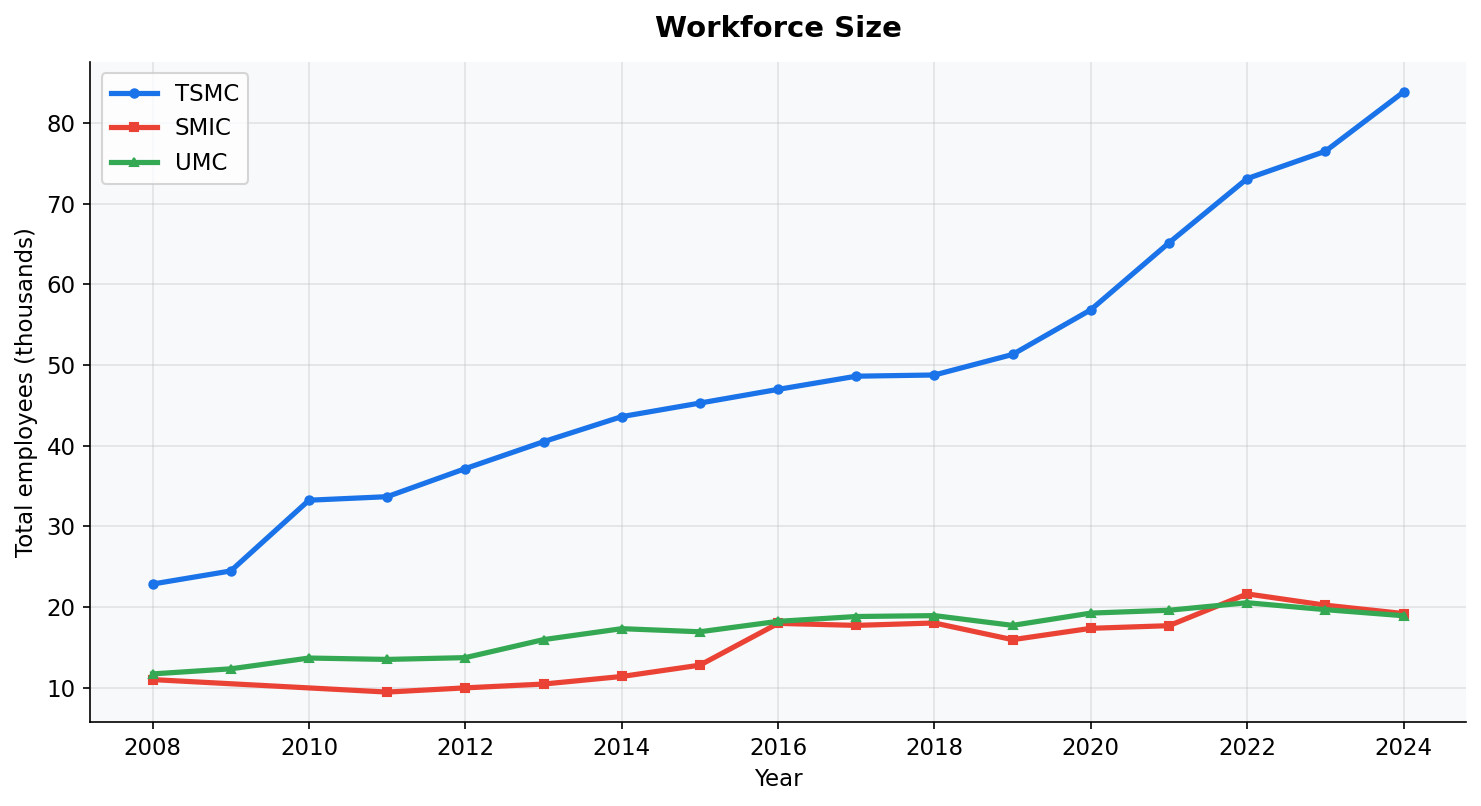
TSMC employed 83,825 people in 2024, roughly 4.4 times the size of SMIC (19,186) or UMC (18,915). TSMC has grown 3.7x since 2008. SMIC and UMC have grown at similar rates, roughly 1.6-1.7x. Both SMIC’s and UMC’s workforces have been shrinking since 2022.
V. SMIC’s workforce is younger
When SMIC first began publishing age data in 2015, 61% of its workforce was aged 30 and below. TSMC and UMC had both been between 46% and 48% in 2008, but by 2015 had fallen to 32% and 35% respectively.
By 2024, UMC had dropped to 16%. TSMC, after hiring over 38,000 workers between 2019 and 2022, had risen back to 35%. SMIC was at 55%. Its youth share had briefly fallen to 49% in 2018, but the improvement reversed. For a company that aspires to manufacture cutting-edge chips, the talent picture has not meaningfully changed in a decade.
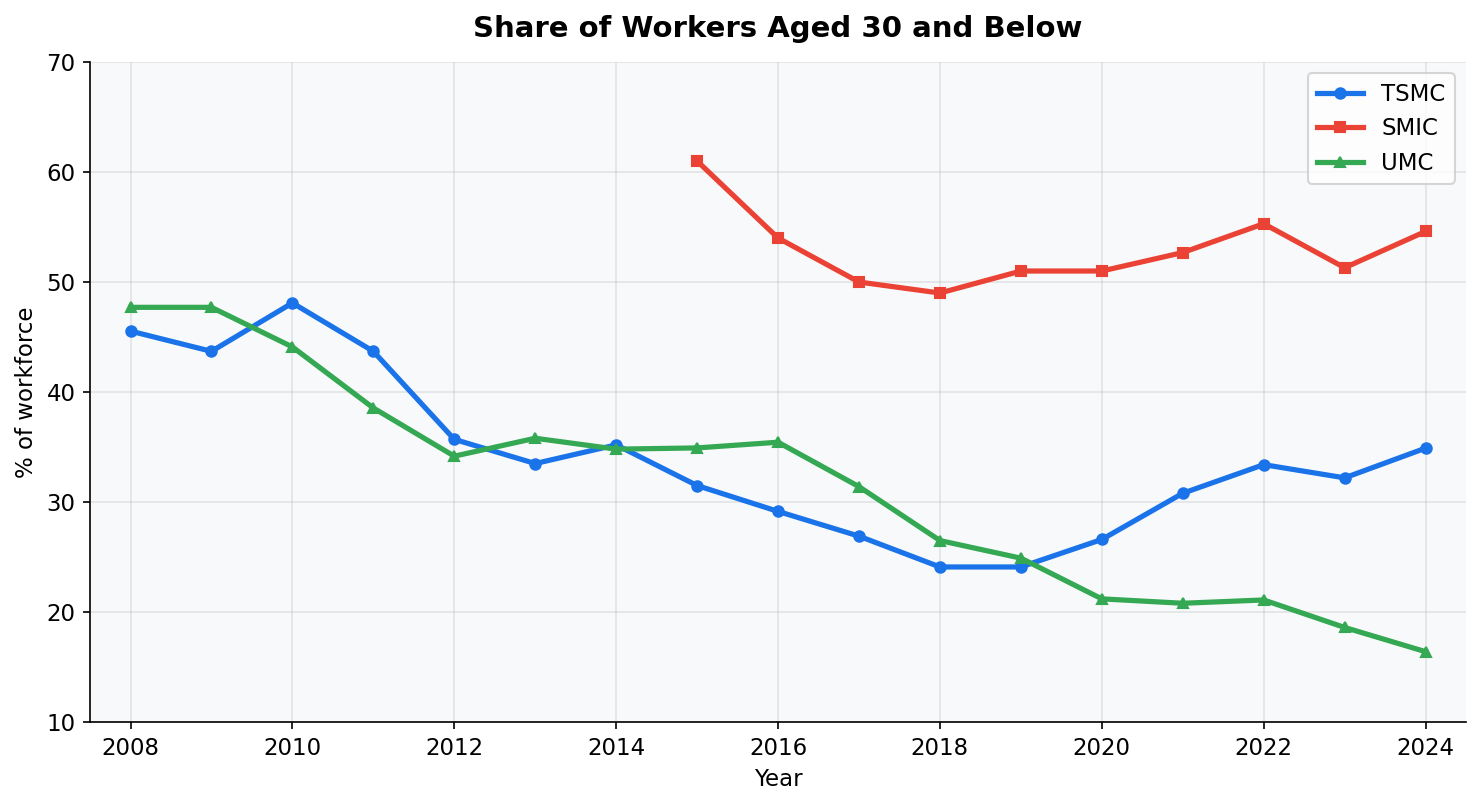
During TSMC’s 2019-2022 hiring spree, 78-81% of new hires each year were aged 18-30. Despite adding over 30,000 young workers in four years, hiring at 10% to 22% of its workforce per year, TSMC’s youth share rose only from 24% to 33%. Its retention of experienced workers was strong enough to absorb the dilution.
The experienced end of the workforce tells the same story in reverse. By 2018, TSMC had more workers aged 40 and above than workers under 30. At SMIC, the 40+ cohort has never exceeded 15%, and has sat around 12-13% for the past four years, outnumbered by the under-30 group by roughly 4 to 1.
SMIC does not publish the age breakdown of its new hires. But if the company were recruiting experienced workers at scale, the 40+ share of its workforce would be growing. It has been flat for four years. SMIC does publish the age breakdown of departures, which I analyze later.
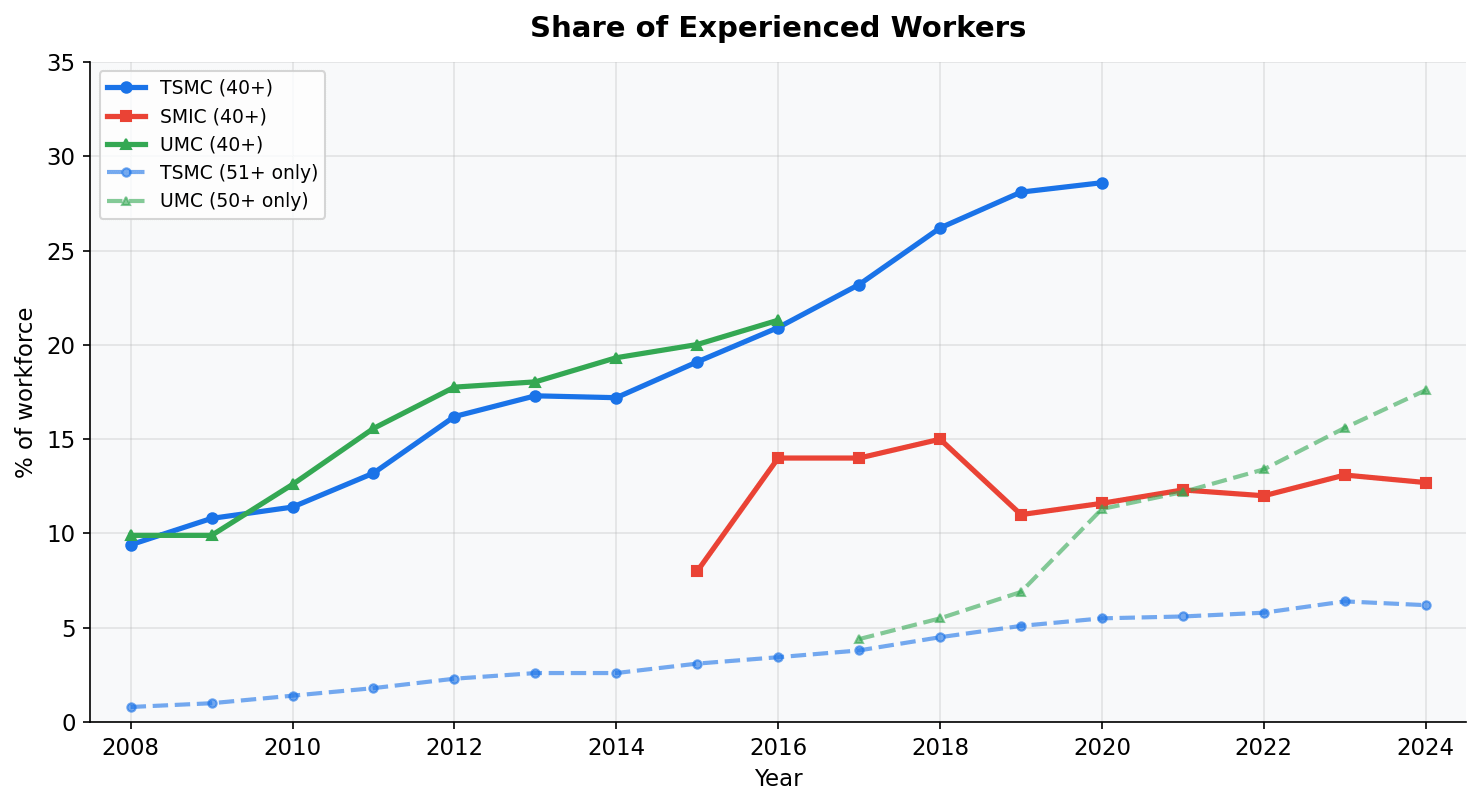
A note on reading this chart: the three companies use different age reporting bins, and these bins have changed over time. TSMC reported finer bins (18-20, 21-30, 31-40, 41-50, 51-60) from 2008 through 2020, then switched to coarser brackets (18-30, 31-50, 51+). UMC similarly reported finer bins through 2016, then switched to under-30, 30-50, and above-50. SMIC has consistently reported 30-and-below, 30-40, and 40-and-above, but only from 2015. The solid lines show the 40+ share, which can be computed from finer bins for TSMC (through 2020) and UMC (through 2016). The dashed lines show the 51+ share (TSMC) and 50+ share (UMC).
VI. Why does SMIC stay so young?
Because its workers keep leaving. The following table and graph show annual employee turnover rates (the share of the workforce that departs each year) across the three foundries.
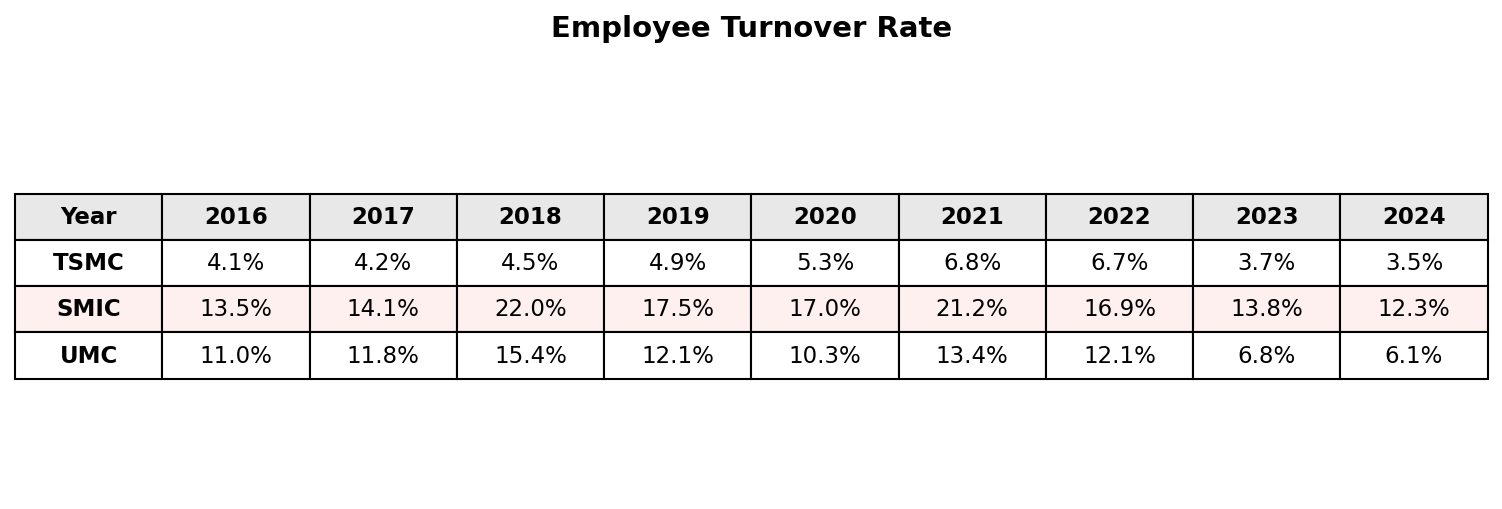
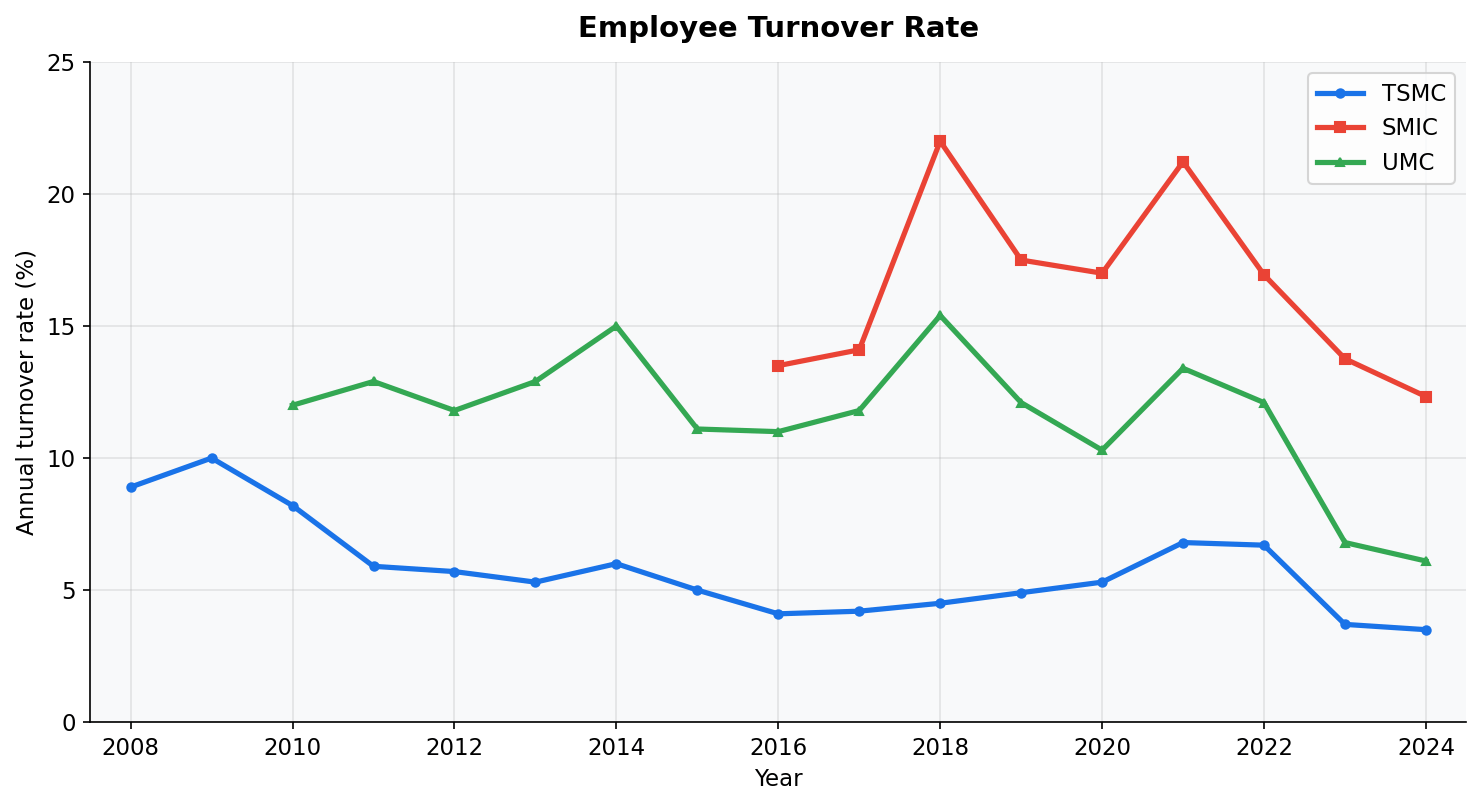
SMIC’s average annual turnover (2016-2024) is 16.5%, 3.4 times TSMC’s 4.9% and 1.5 times UMC’s 11.0%.
One natural objection is that SMIC, founded in 2000, is still a young company, and TSMC may have looked similar at the same point in its corporate life. Fortunately, TSMC’s CSR reports go back to 2007, which means we can compare the two foundries at matched ages rather than matched calendar years.
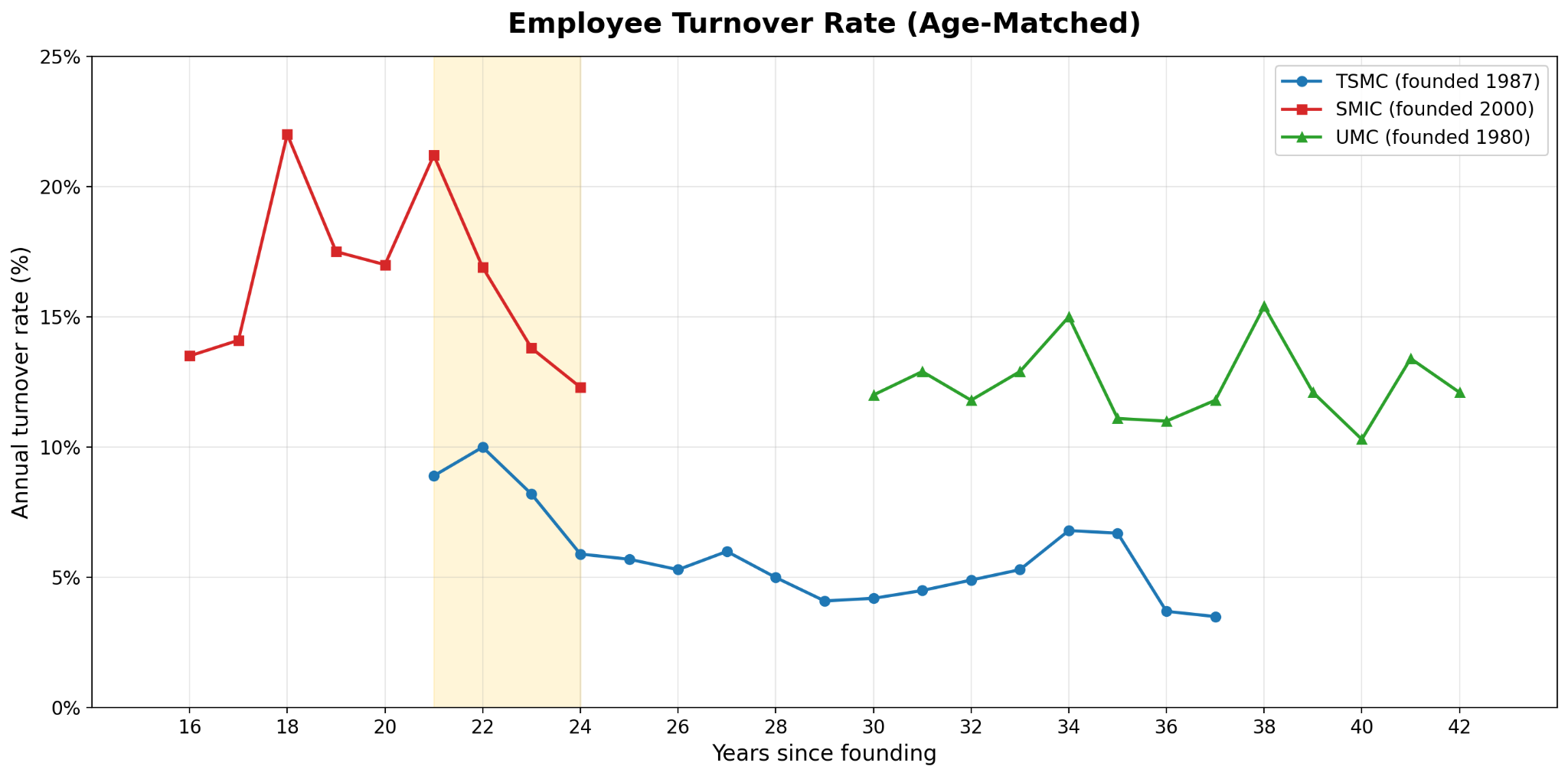
From 2008 to 2011, when TSMC was aged 21 to 24, its reported turnover averaged 8.2% per year and never exceeded 10%. From 2021 to 2024, when SMIC was aged 21 to 24, its reported turnover averaged 16.1% per year and never fell below 12%. SMIC’s best year at this stage of its life is worse than TSMC’s worst. At equivalent points in their corporate lifecycles, TSMC was roughly twice as good at retaining people as SMIC is now.
Who is leaving?
From 2016 to 2018, departures at SMIC were overwhelmingly concentrated among workers aged 30 and below, who left at 1.4-1.6x their share of the workforce. The 30-40 cohort was relatively sticky, leaving below their workforce share.
However, by 2024, the 30-40 group accounted for 36% of departures while making up 33% of the workforce. This cohort had grown from 31% of the workforce in 2015 to 38% in 2019, suggesting a middle layer was building. By 2024, it had fallen back to 33%. These are the workers who should be teaching the next generation, which makes their departure a different kind of problem from early-career churn. The mid-career pipeline that should be producing SMIC’s next generation of experienced engineers has started to thin rather than thicken.
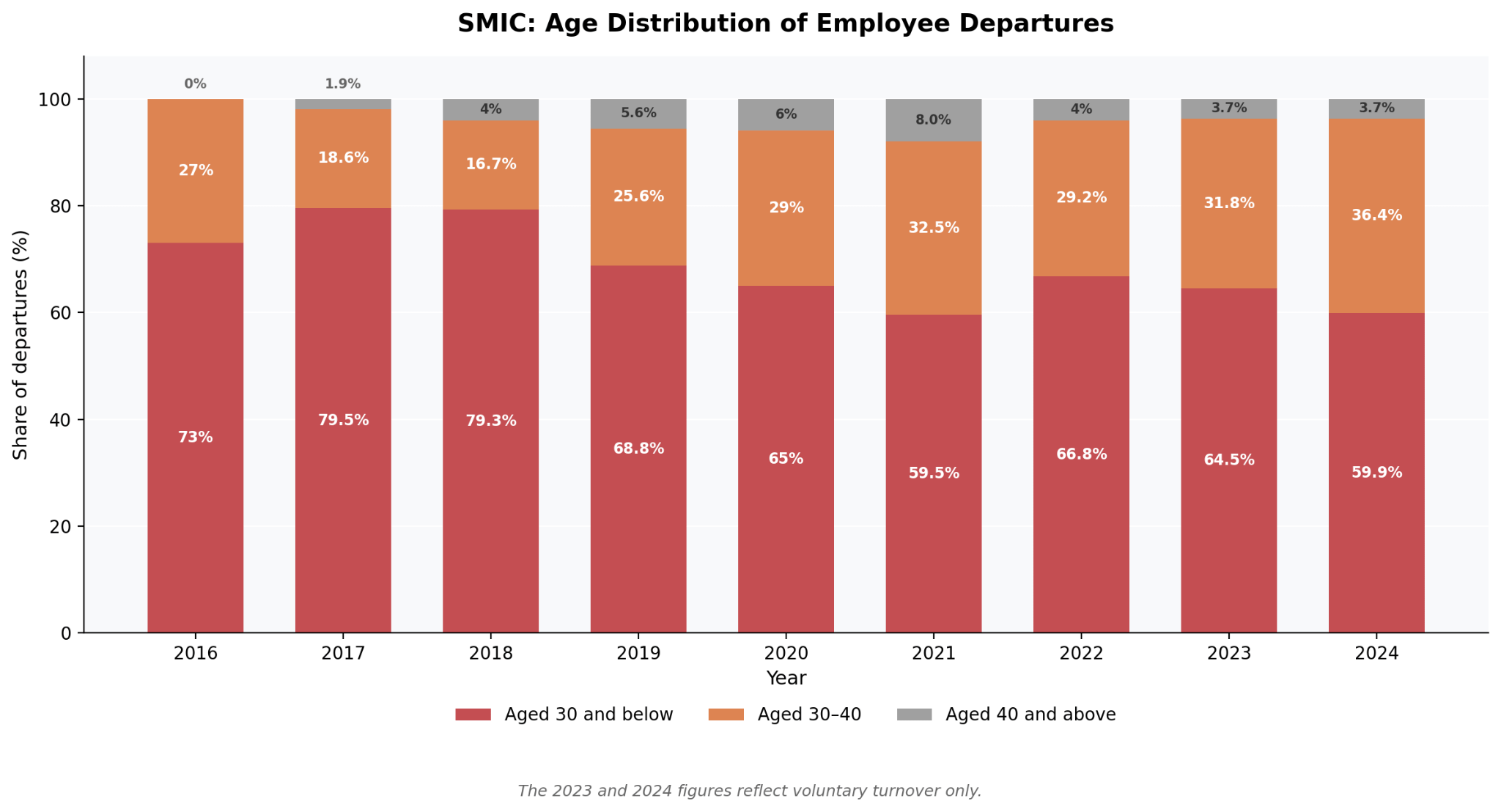
This data does not tell us where SMIC’s departing workers go. SMIC shows that turnover is concentrated in Shanghai and Beijing (presumably because the density of alternative employers is highest there).
VII. What can we conclude?
Taiwan understood, from the very beginning, that semiconductor manufacturing knowledge lives in people. It built ITRI to move that knowledge into the ecosystem, and TSMC was founded to lock it in. TSMC’s low turnover rate has allowed tacit knowledge to accumulate across generations of engineers.
SMIC is cycling through workers at 3-4 times TSMC’s rate. The workers who should be becoming the next generation of teachers are leaving before they get there, and new students keep arriving faster than the remaining experienced engineers can train them.
Richard Chang, SMIC’s founder, argued in a 2021 speech in Shanghai that China’s biggest obstacle to semiconductor self-sufficiency is not capital or policy support but a chronic shortage of talent. Cultivating that talent, he said, “is not only about academic education, but also practice, such as experience in factories.”
SMIC has money, government support, and access to a growing pool of Chinese engineering graduates. It does not (yet) have enough engineers with decades of experience working inside a fab. On current trends, capital and policy support are unlikely to be sufficient to close the gap with TSMC, because building that experience base requires retaining workers over many years.
This workforce data is just one lens among several for assessing whether China’s chipmaking indigenization efforts are succeeding. Others include technology transfers, fab buildout, export controls, and the scale of government investment and industrial policy.
VIII. Sources
All data comes from publicly available CSR and ESG reports: TSMC (2007-2024), UMC (2008-2024), and SMIC (2008-2024, with gaps in earlier years). Please DM me for a compiled spreadsheet with page-level citations for each data point.
IX. Acknowledgements
Thanks to Erich Grunewald, Liya Palagashvili, and Tyler Cowen for comments.
Of course, the opposite situation exists elsewhere. In the United States, a third of semiconductor workers are aged 55 or older. In Germany, a third of the semiconductor workforce is expected to retire within the decade. An aging workforce without enough young entrants is also a problem; experienced and inexperienced workers should coexist in workable proportions.
Though metrology tools, which measure features on a wafer between process steps, do provide fast feedback at individual steps.
SMIC makes chips for Huawei’s consumer smartphones, but Huawei’s AI accelerators are a different story. Teardowns of the Ascend 910B and 910C, Huawei’s flagship AI chips, have found that the compute dies were manufactured by TSMC, reportedly obtained through shell companies before TSMC cut off the intermediary. There is no confirmed teardown evidence of SMIC manufacturing Huawei AI chips at scale, though this is subject to change.
Great post Elsie! I'd be very interested to see the average current tenure of employees at each of the three foundries. I know age will be a decent proxy of experience, but I would bet that experience at that particular foundry is very important.